Texas-Style Mop Sauce
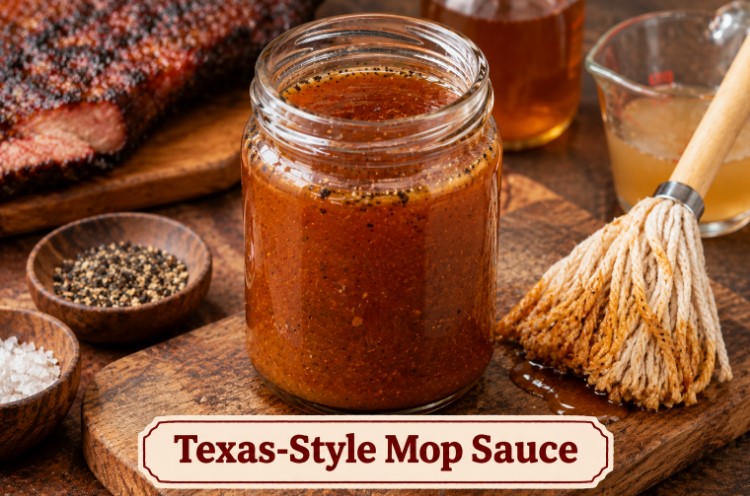
Texas mop sauce is a thin seasoned liquid brushed or dabbed onto meat during barbecue cooking. Unlike a sticky glaze, it is meant to spread in a light layer, adding surface flavor as the meat cooks. A stock-and-vinegar version works well for brisket and beef ribs, while a lighter batch can be used on chicken. Mopping is optional and is not a guarantee of juicy meat.
Should you mop your brisket at all?
Texas barbecue is not one method. Some pitmasters use a mop, while others leave the meat undisturbed. AmazingRibs documents a traditional mop associated with Walter Jetton, illustrating the use of thin basting liquids in Texas cooking. A discussion in r/smoking also shows that cooks disagree about how often to mop after bark forms. Treat those experiences as preferences, not fixed rules.
If your smoker holds steady heat and your brisket develops a good crust, there may be no reason to open it repeatedly. A BBQ mop sauce is most useful when you deliberately want to add a thin layer of seasoning. It does not force moisture deep into a large cut or correct meat that has already been overcooked.
How to apply a mop without washing away the bark
- Allow the rub and exterior to set first. Test a small spot gently; if seasoning lifts easily, wait.
- Pour a small amount of clean sauce into a separate working bowl.
- Use a food-safe barbecue mop or silicone brush to dab a light layer rather than scrubbing the surface.
- Close the cooker promptly. Wait until the surface is no longer wet before considering another application.
- Stop mopping if the bark softens or the cooker struggles to regain its temperature.
There is no universal interval for applying mop sauce for brisket. A large offset cooker and a small insulated smoker react differently to an open lid. Check when you already need to tend the fire or inspect the meat, rather than opening the lid solely to follow a timer.
A savory Texas mop sauce recipe
This BBQ mop sauce recipe is an alcohol-free, research-informed adaptation that emphasizes a thin consistency. It is not a reproduction of a particular pitmaster’s formula and has not been kitchen-tested. Use a saucepan, whisk, separate working bowl and food-safe brush.
Prep: 5 minutes. Cook: 5 minutes. Total: 10 minutes. Yield: about 2 cups, or sixteen 2-tablespoon portions before application.
- 1 1/2 cups unsalted beef stock
- 1/4 cup apple cider vinegar
- 1/4 cup water
- 1 tablespoon suitable alcohol-free Worcestershire-style sauce
- 1 teaspoon ground black pepper
- 1/2 teaspoon onion powder
- 1/2 teaspoon garlic powder
- 1/4 teaspoon fine salt, optional depending on the stock
Combine stock, vinegar and water in the pan. Stir in the Worcestershire-style sauce, pepper, onion powder, garlic powder and salt if needed. Heat gently for about five minutes to blend the seasonings. Do not reduce it into a thick sauce. Remove from the heat and divide into clean portions. Refrigerate anything you will not use promptly.
A Texas brisket mop sauce needs to flow off the brush readily. If it seems too strong, add a little unsalted stock or water. Check the ingredients of packaged stock and Worcestershire-style sauce for dietary suitability; some contain fish, soy or wheat. If you cannot find a suitable condiment, leave it out and adjust the salt and vinegar instead.
Mop, spritz or finishing sauce?
| Method | How it behaves |
|---|---|
| Texas style mop sauce | A thin seasoned liquid dabbed onto a set surface. |
| Spritz | A fine mist, usually with few or no solids that could clog the nozzle. |
| Thick finishing sauce | A coating or table condiment, often applied near the end of cooking. |
A Texas BBQ mop sauce may be more savory than a tomato glaze. If you want a sticky finish, use a separate thick barbecue sauce toward the end. A thin vinegar-based Carolina sauce is another option, though its flavor and regional background differ.
Making it work on different cuts
For a brisket mop sauce, unsalted beef stock provides a savory base without building too much salt on a long cook. On beef ribs, apply gently around the bones where the surface is already firm. A Texas mop sauce for chicken can use unsalted chicken stock instead of beef stock; use a clean brush and avoid opening the grill repeatedly. Cook chicken to at least 165°F internally.
For lamb, a little extra black pepper can complement the rich flavor. For vegetables, a small amount of the sauce may be brushed on just before serving, but use vegetable stock if needed. A thin mop is not the same as a marinade; it is designed primarily for surface application during cooking.
What goes wrong during mopping?
The bark comes off: the exterior has not set or the brush is too rough. Stop mopping until the crust is firm. The smoker loses heat: reduce lid openings and keep each application brief. The meat tastes too salty: repeated coats of salted stock concentrate seasoning; switch to unsalted liquid. The sauce pools: use less on the brush and dab rather than pour. The sauce tastes harsh: dilute the vinegar with stock before applying.
If the brisket is already dry, repeatedly mopping the outside will not restore its internal moisture. Slice only what you need and serve with a clean warm sauce separately. Adjust your cooking method on the next cook rather than expecting the mop to rescue the meat.
Food safety during a long cook
Do not leave a large bowl of stock-based sauce beside a warm smoker all day. Keep clean unused portions refrigerated or held safely hot at 140°F or above. Take out small working amounts, discard those that contact the brush used on raw or partially cooked meat, and use fresh clean sauce for serving. USDA advises boiling used marinade if it is to be reused on meat; discarding contaminated mop portions is the simpler approach here.
Refrigerate clean leftovers at 40°F or below within two hours, or one hour above 90°F. Use within three to four days as conservative leftover guidance or freeze promptly. Estimated nutrition per 2 tablespoons of unapplied sauce is approximately 2–8 calories and less than 1 g each of fat, carbohydrate and protein. Sodium depends on the stock, condiment and optional salt. Actual intake depends on how much remains on the meat.
FAQs
Can I make a mop sauce recipe without stock?
Yes, water and vinegar can form a lighter base, though the savory flavor will be weaker.
Do I have to mop every hour?
No. Apply only when the bark is set and the cooker can recover heat easily.
Can I mop with a spray bottle?
A spritz is a related technique, but pepper particles may clog a nozzle. Strain the liquid if using a sprayer.
Will mopping extend cooking time?
It may, especially when frequent lid openings cool the cooker and wet the surface.
Can I add sugar?
A small amount is possible, but repeated sweet coats can darken. This recipe is intentionally unsweetened.
Do I mop after wrapping?
Usually there is little benefit once the meat is wrapped. Avoid opening the wrap repeatedly.
Can I serve the mop as a dip?
Only use a clean portion that has not contacted the working brush or raw meat.
Should the mop be thick?
No. A thin liquid spreads easily; a thick coating behaves more like a glaze.
Can I use a household paintbrush?
Use a food-safe brush intended for cooking. Household brushes may contain unsuitable materials.